
Understanding Seal Performance During Packaging
Emballage des dispositifs médicaux plays a critical role in maintaining product sterility, safety, and reliability throughout storage, transportation, and clinical use. Unlike ordinary packaging, medical packaging must withstand strict quality requirements because seal failure may directly affect product protection.
During high-speed form-fill-seal operations, packaging materials are often exposed to mechanical stress immediately after sealing, when the seal is still hot and has not reached its final strength. This early-stage sealing performance is evaluated through the Test de collage à chaud, which measures the ability of a hot seal to resist separation forces before complete cooling.
Le Test de collage à chaud provides important information about sealing behavior and helps packaging engineers select suitable films, optimize sealing parameters, and reduce the risk of package failure during production.
Hot Tack Test and ASTM F1921 Evaluation of Hot Tack Strength
Le ASTM F1921 standard provides a widely recognized method for measuring the hot tack performance of heat-sealed flexible packaging materials. It evaluates the strength of a seal immediately after the sealing process while the polymer layers are still in a heated condition.
L'objectif de la Test de collage à chaud is different from traditional heat seal strength testing. Heat seal testing generally evaluates the strength of a fully cooled seal, while hot tack testing focuses on the critical period immediately after sealing.
According to ASTM F1921, two film strips are sealed together under controlled conditions, including:
- Température de scellage
- Pression d'étanchéité
- Contact time
- Cooling or delay time
- Testing speed
After the sealing jaws open, the sealed sample is pulled apart at a controlled speed. The maximum force required to separate the seal is recorded as Résistance au collage à chaud.
This measurement helps determine whether a packaging material can maintain seal integrity during automated packaging processes.
Importance of Hot Tack Strength in Medical Device Packaging
In medical packaging production, sealed packages may experience tension, movement, and internal pressure before the seal has fully cooled. For example, during pouch filling, transportation through packaging equipment, or product handling, weak hot seals may open prematurely.
Insufficient Résistance au collage à chaud can lead to:
- Seal opening during production
- Product contamination risks
- Increased packaging defects
- Reduced manufacturing efficiency
Therefore, evaluating hot tack performance is essential when developing packaging systems for medical devices, sterile barriers, and flexible packaging structures.
Le Test de collage à chaud allows engineers to compare different packaging films and determine which material combinations provide better early seal resistance.
ASTM F1921 Hot Tack Test Methods and Testing Principle
ASTM F1921 describes two primary approaches for evaluating hot tack performance.
Method A: Fixed Delay Method
In Method A, the testing system measures hot tack strength at selected time intervals after the sealing jaws open. The instrument creates a relationship between seal strength and cooling time.
This method is useful for understanding how quickly a seal develops strength after sealing. It helps engineers identify the optimal balance between sealing temperature, cooling time, and production speed.
Method B: Variable Delay Method
In Method B, the operator selects a specific delay time after sealing. The instrument measures the maximum force required to separate the seal at that condition.
This method is commonly used for comparing different materials or evaluating packaging performance under specific production conditions.
Both methods provide valuable information about material behavior during the early sealing stage.
How to Perform a Hot Tack Test
A typical Test de collage à chaud includes several controlled steps:
1. Prepare Test Samples
Flexible packaging films are cut into suitable strips. The samples may include identical films or different film combinations depending on the application.
2. Set Sealing Parameters
The sealing conditions are adjusted according to the material requirements:
- Température de scellage
- Pression d'étanchéité
- Temps de séjour
- Test speed
Proper parameter control ensures reliable comparison between materials.
3. Perform Heat Sealing
The film strips are placed between heated sealing jaws. The jaws apply pressure for a defined period to create the seal.
4. Measure Seal Separation Force
After sealing, the sample is automatically pulled apart. The instrument records the force curve and calculates the maximum separation force.
5. Analyze Results
The measured Résistance au collage à chaud helps determine whether the material meets packaging process requirements.
Selecting a Suitable Hot Tack Tester for Medical Packaging Applications
Fiable Emballage des dispositifs médicaux evaluation requires testing equipment that can accurately control sealing and pulling conditions, such as the Cell Instruments Hot Tack Tester.
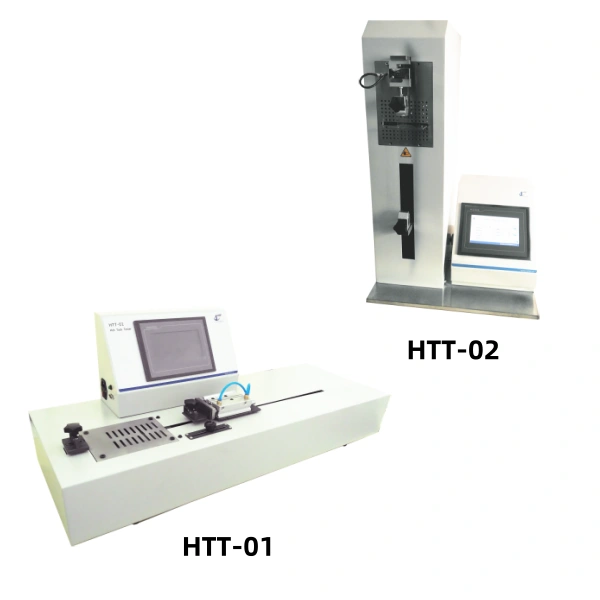
Le Cell Instruments HTT-01 Hot Tack Tester provides multiple testing functions, including hot tack testing, heat seal testing, peel testing, and tensile testing. It is suitable for laboratories that require flexible testing capability for packaging material evaluation.
For applications requiring ASTM F1921 compliance, the Cell Instruments HTT-02 Hot Tack Tester supports both Method A and Method B testing approaches. With high-speed testing capability, it is suitable for evaluating packaging films used in modern high-speed sealing processes.
By using appropriate hot tack testing equipment, packaging manufacturers can better understand seal formation behavior and improve the reliability of medical packaging systems.
Applications of Hot Tack Testing in Packaging Quality Control
Le Test de collage à chaud is widely applied in:
- Medical device pouches
- Sterile barrier packaging
- Pharmaceutical flexible packaging
- Food packaging films
- High-speed form-fill-seal applications
For medical packaging manufacturers, hot tack analysis provides valuable data during material selection, process validation, and production troubleshooting.
Conclusion
Le Test de collage à chaud is an important evaluation method for understanding the early sealing performance of flexible packaging materials. Based on ASTM F1921, this test provides quantitative measurement of Résistance au collage à chaud, helping manufacturers evaluate whether seals can withstand mechanical stress immediately after formation.
Pour Emballage des dispositifs médicaux, reliable hot tack performance is essential to maintaining package integrity and protecting product safety. Through standardized testing methods and accurate measurement systems, manufacturers can optimize sealing processes and achieve more consistent packaging quality.
 Français
  English
  العربية
  Български
  Čeština
  Dansk
Dansk  Deutsch
  Ελληνικά
  Español
  Eesti
Eesti  Suomi
Suomi  Magyar
  Bahasa Indonesia
  Italiano
  日本語
日本語  한국어
한국어  Lietuvių kalba
  Latviešu valoda
  Norsk bokmål
  Nederlands
  Polski
  Português
  Română
  Русский
  Slovenčina
  Slovenščina
  Svenska
  Türkçe
  Українська
  Tiếng Việt
  ไทย
ไทย  עִבְרִית
  हिन्दी
  繁體中文
繁體中文