
Milk packaging operates under demanding conditions where high-speed form-fill-seal processes, elevated temperatures, and immediate mechanical stress occur almost simultaneously. For milk packaging, seal failure often happens before the seal cools down, not after storage. This makes hot tack performance a decisive quality factor. The milk packaging hot tack test focuses on measuring seal strength while the seal is still hot, providing critical insight into real production risks.
Hot Tack Test Method: Hot Tack Strength in Milk Packaging
he Hot Tack Test method, defined in Norma ASTM F1921, establishes a standardized approach to measure Resistencia al calor immediately after heat sealing. Unlike conventional seal strength tests that evaluate fully cooled seals, ASTM F1921 addresses the most vulnerable moment in milk packaging—the instant the jaws open and the package starts moving.
In milk packaging, seals must resist:
- Vertical pull during filling
- Horizontal stress during conveyor transfer
- Product weight acting on still-molten seal layers
Hot tack strength quantifies the seal’s resistance to peeling forces during this short but critical window.
Why Hot Tack Performance Matters for Milk Packaging
Milk packaging materials typically include multilayer structures designed for barrier protection and heat sealability. However, excellent final seal strength does not guarantee adequate hot tack performance.
Insufficient hot tack strength can lead to:
- Seal opening during form-fill-seal operations
- Product leakage and contamination
- Line stoppages and increased waste
- Reduced consumer confidence
By applying a milk packaging hot tack test early in material selection and process optimization, manufacturers can prevent costly failures before commercial production begins.
How the Milk Packaging Hot Tack Test Works
During the test, two film strips—either identical or dissimilar—are sealed together under controlled temperature, pressure, and dwell time. Some systems allow a single strip to be sealed and separated automatically, improving repeatability.
Once sealing completes:
- The seal jaws open
- The sample is immediately pulled apart at a constant speed
- The force required to peel the seal is continuously recorded
This force reflects the hot tack strength of the milk packaging material under defined conditions.
Practical Applications in Dairy Packaging Operations
The milk packaging hot tack test supports:
- Qualification of new packaging films
- Optimization of sealing parameters
- Troubleshooting seal failures on production lines
- Supplier comparison and incoming material inspection
By correlating test results with real machine behavior, quality teams reduce trial-and-error adjustments and improve line stability.
Supporting ASTM F1921 Testing with Reliable Equipment
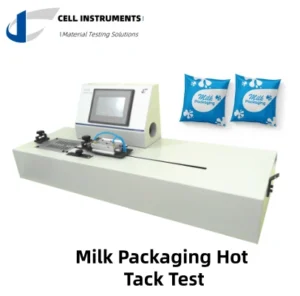
Accurate hot tack evaluation depends on precise control of sealing conditions and peel speed. The Cell Instruments Hot Tack Tester HTT-01 supports ASTM F1921 testing by enabling stable temperature control, repeatable sealing pressure, and consistent peel motion.
When integrated into milk packaging quality programs, the HTT-01 helps laboratories generate reproducible data that reflects actual production conditions without duplicating the sealing line itself.
Conclusion
Milk packaging faces unique challenges where seal integrity must develop instantly under heat and stress. The milk packaging hot tack test, guided by the Hot Tack Test method in Norma ASTM F1921, provides a practical and standardized way to evaluate Resistencia al calor at the moment it matters most.
By applying this method and using reliable testing solutions such as the Cell Instruments HTT-01, packaging professionals can improve material selection, stabilize production, and ensure safe, leak-free milk packaging from filling to consumer use.
 Español
  English
  Français
  Русский
  العربية
  日本語
日本語  한국어
한국어  Tiếng Việt
  ไทย
ไทย  Português
  עִבְרִית
  हिन्दी
  繁體中文
繁體中文